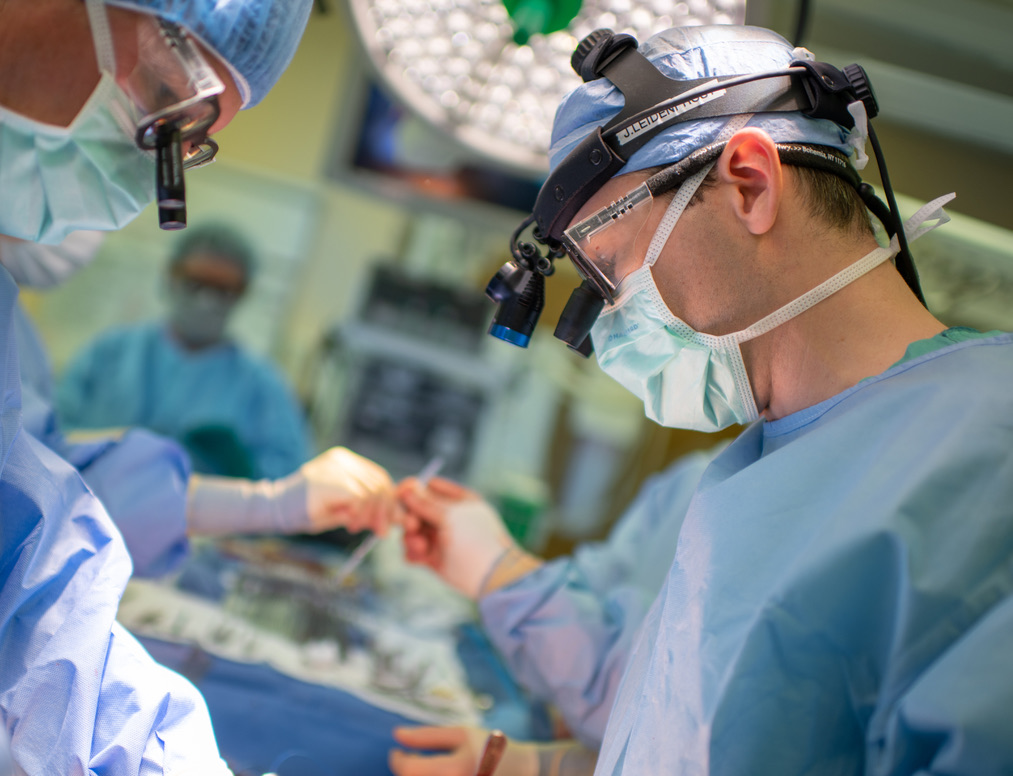
How your trip usually goes
Every patient is different, but most out-of-town trips follow the same shape.
Before you travel
Virtual visit
We review your records and meet by video, so you arrive with a plan.
In St. Louis
Surgery and hospital stay
Your operation and recovery at St. Luke’s Hospital in Chesterfield.
After discharge
About a week nearby
Most patients stay close to the hospital for about a week after discharge before flying home.
Back home
Follow-up by video
We check in by video and coordinate with your local cardiologist.
Virtual visits
You shouldn’t have to fly to St. Louis just to find out whether you need surgery. For many patients, the first visit and the follow-up after you’re home can happen by video.
Video visits must take place while you are physically located in a state where Dr. Leidenfrost is licensed. [Confirm: states licensed.]
1 · Send your records
Your heart catheterization, echocardiogram and any CT scans, with your cardiologist’s notes. [Confirm: how patients send records and imaging.]
2 · Meet by video
We talk through your diagnosis, your options and my recommendation. Bring the family members who’ll help you decide. [Confirm: video platform, e.g. patient-portal video visit.]
3 · Plan your trip
If surgery is the right choice, our office helps schedule pre-operative testing, your surgery date and your stay.
4 · Follow up from home
After you’re home, we check in by video and keep your local cardiologist and primary care doctor in the loop. [Confirm: timing of the follow-up visit.]
Where to stay near the hospital
St. Luke’s Hospital is at 232 South Woods Mill Road in Chesterfield. Plan on about a week nearby after discharge. For a stay that long, a suite with a kitchen and a first-floor or elevator room makes life easier. When you book, ask whether the hotel offers a hospital or medical rate.
Distances are approximate. Listings change; please call the hotel to confirm. We don’t have a business relationship with these hotels.
| Hotel | Address | From hospital |
|---|---|---|
| Marriott St. Louis West | 660 Maryville Centre Drive, Town and Country, MO 63141 | 0.6 mi |
| Fairfield Inn & Suites Chesterfield | 1065 Chesterfield Parkway East, Chesterfield, MO 63017 | 2.6 mi |
| Sonesta ES Suites Chesterfield | 15431 Conway Road, Chesterfield, MO 63017 | 2.8 mi |
| Hyatt Place Chesterfield | 333 Chesterfield Center East, Chesterfield, MO 63017 | 3.1 mi |
| Hampton Inn Chesterfield | 16201 Swingley Ridge Road, Chesterfield, MO 63017 | 3.2 mi |
| Homewood Suites by Hilton Chesterfield | 840 Chesterfield Parkway West, Chesterfield, MO 63017 | 3.6 mi |
| Residence Inn West County St. Louis | 12815 Daylight Drive, St. Louis, MO 63131 | 4.0 mi |
| Residence Inn Chesterfield | 16875 North Outer 40 Road, Chesterfield, MO 63005 | 4.5 mi |
Getting home safely
We’ll clear you to travel at your follow-up visit before you leave. Until your breastbone heals, these are the rules of the road.
Mind your breastbone
For the first 6 weeks while it heals: don’t lift more than [confirm: 5–10] pounds, don’t push or pull with your arms (including pushing up from a chair), and don’t reach overhead, out to the sides, or behind your back with both arms.
Ride, don’t drive
Don’t drive for about 6 weeks. Riding as a passenger is fine. Always wear your seatbelt; a small pillow between the belt and your chest makes it more comfortable.
Stop every hour on the road
Long sitting raises the risk of blood clots in the legs. On a car trip, stop about once an hour and walk for a few minutes.
On the plane, keep moving
Ask for an aisle seat. Walk the aisle once or twice an hour, and pump your calves (toes up, toes down) while seated. Drink plenty of water.
Let someone else carry the bags
Don’t lift your suitcase into the overhead bin or off the carousel. Travel with a companion, use the airline’s baggage help, or ship bags home ahead. Ask the airline for wheelchair assistance through the airport — long concourse walks are tiring the first weeks.
Carry your paperwork
Keep your medication list, discharge instructions and our office number in your carry-on, with your medications. If you received a heart valve, carry your implant card.
Call us — or get help right away — if you have:
Chest pain or shortness of breath that’s new or worse · pain, swelling or warmth in one leg · fever over 100.4°F · redness, drainage or opening of your incision · a fast or irregular heartbeat that doesn’t settle. For a medical emergency while traveling, call 911.
Consultations and second opinions
Talk with Dr. Leidenfrost
Whether you’ve just been diagnosed or have already been told you need surgery, I’m glad to review your case and talk through your options — including a second opinion on a recommendation you’ve received.
Call (314) 434-3049Monday–Friday, 8 a.m.–4 p.m. Central
1 · Call our office
Tell our office you’d like a consultation or a second opinion.
2 · We gather your records
Your records, imaging and prior tests — we do the chasing, not you.
3 · An honest assessment
Whether surgery is right, whether a less invasive option exists, and what realistic outcomes look like.
4 · Your decision
Take it wherever you want — to us, to your current doctor, or home to your family.